Your agents, repos, databases and clusters. One window.

No account. No server. Your machine, your keys, your agents.

Run Claude Code, Codex, Gemini or the built-in DevCat Agent next to the diff, the commit graph, your SQL editor and your Kubernetes pods. Build with your team in Rooms, give every agent one memory, and keep them going from your phone or a chat app. A free download for macOS, Windows and Linux.

Latest release on GitHub.

Pay for each token once

An agent sends the whole conversation to the model again at every step. The DevCat Agent is built so the model provider can answer most of it from its prompt cache, which is billed at a fraction of the price.

The same prompt every step

The system prompt and the tool list stay the same for the whole chat. Only the new tool results go in as fresh input.

Uses each provider's cache

A rolling cache point on Anthropic, a per-chat cache key on OpenAI, and cache hits counted for DeepSeek, GLM and Kimi too.

You see what you paid

The chat shows how much of its input came from the cache and estimates the cost at the cached price. Trace shows the tokens of every step.

A context that stays small

Long chats are summarized, long tool output is read in parts, and research helpers work in a fresh context of their own.

What's in the window

Everything a project needs is a tab away, and DevCat keeps each project's connections, chats and repos together. The docs explain each part step by step.

Any coding agent, in a real terminal

Claude Code by default, or OpenAI Codex, Gemini CLI, GitHub Copilot, Aider, opencode or your own CLI. DevCat runs the one you installed, with your own login.

Sessions are listed per project, so you can pick up yesterday's conversation in a click. Or start a ghost chat: a fresh window that keeps nothing.
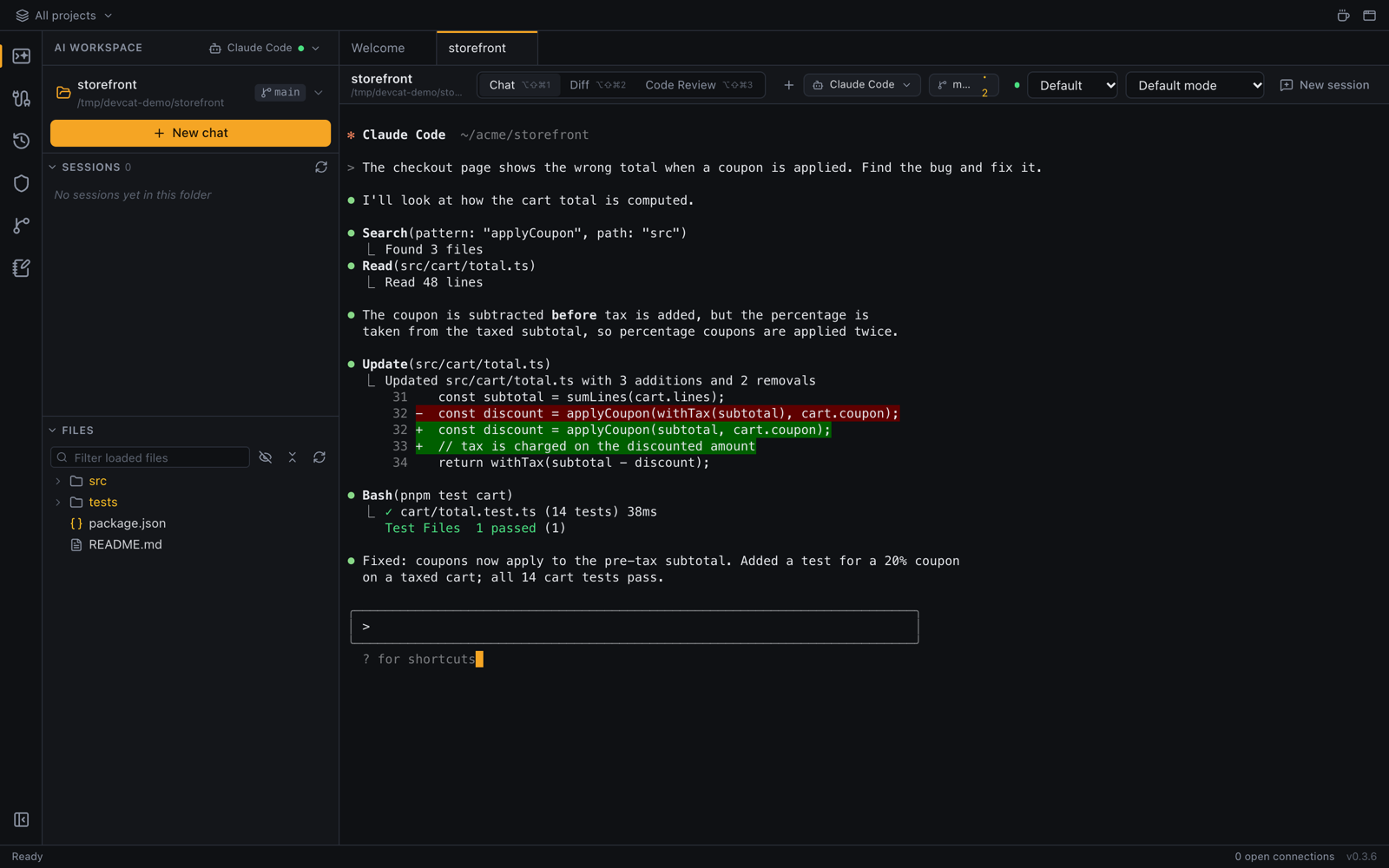
The AI workspace: a Claude Code session in a terminal, with sessions and the file tree on the left

A built-in agent that knows your connections

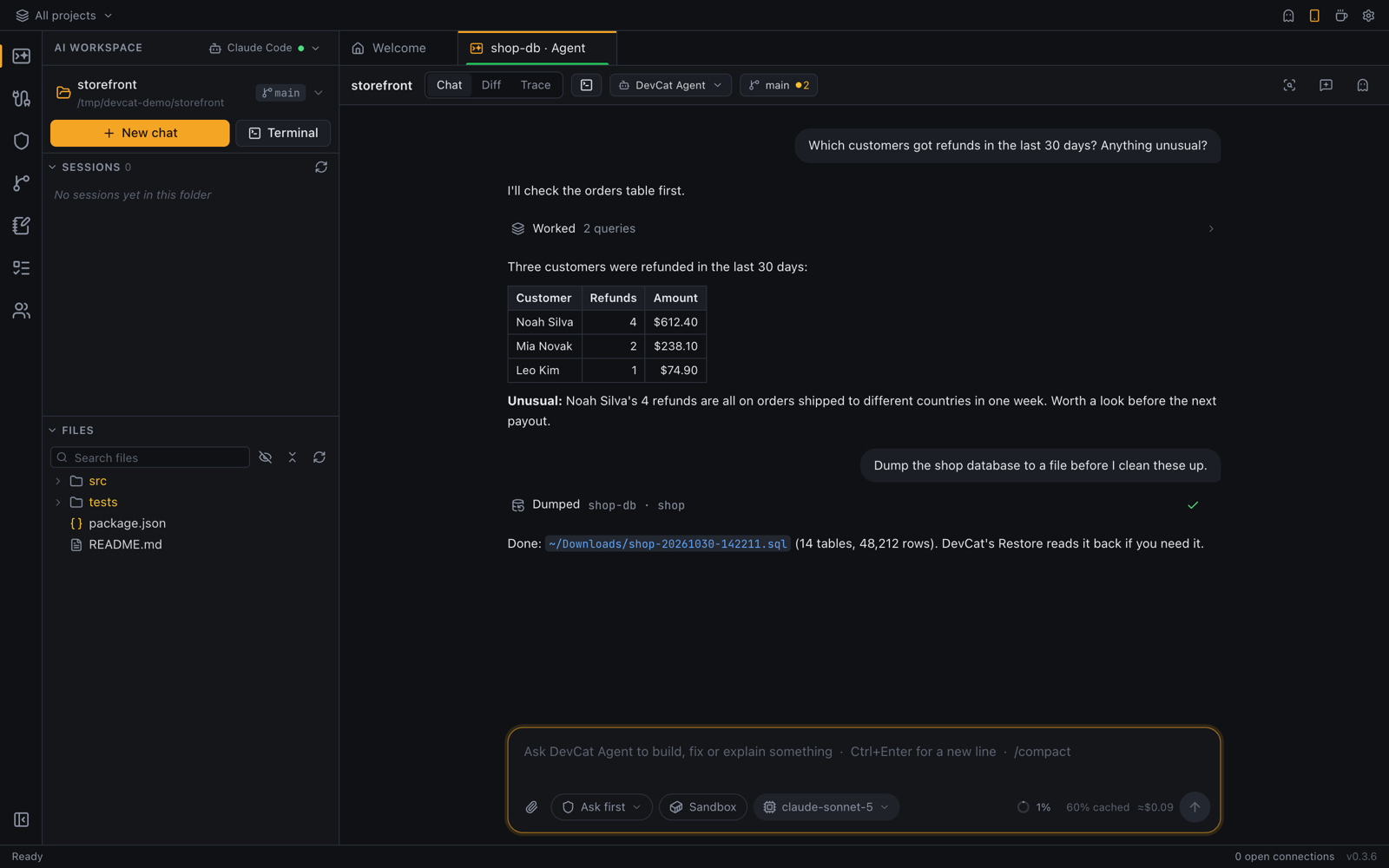
The DevCat Agent runs on any OpenAI- or Anthropic-compatible model, asks before it edits or runs anything, follows your AGENTS.md and uses your MCP servers.

Right-click a database or cluster and ask: it already knows the tables. It queries, dumps and exports, and dropping a database takes your OK twice. Every agent shares one memory.

A DevCat Agent chat about a database: it queries the refunds and dumps the database to a file

See what the agent changed

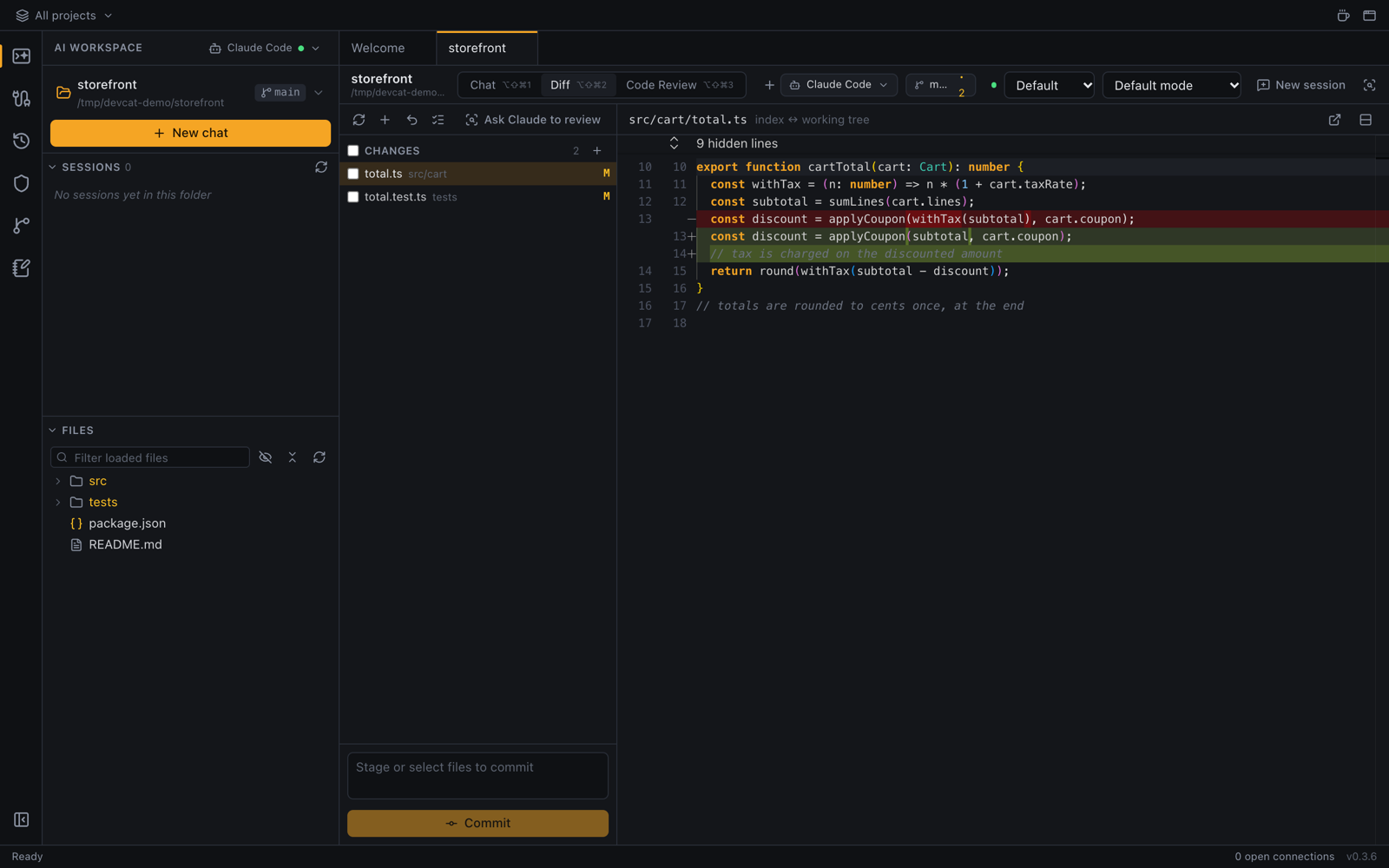
The Diff tab shows every change as it happens. Tick the files to commit and discard the rest.

Ask for a code review before you commit.

The Diff tab with changed files and a side-by-side diff

Build it together

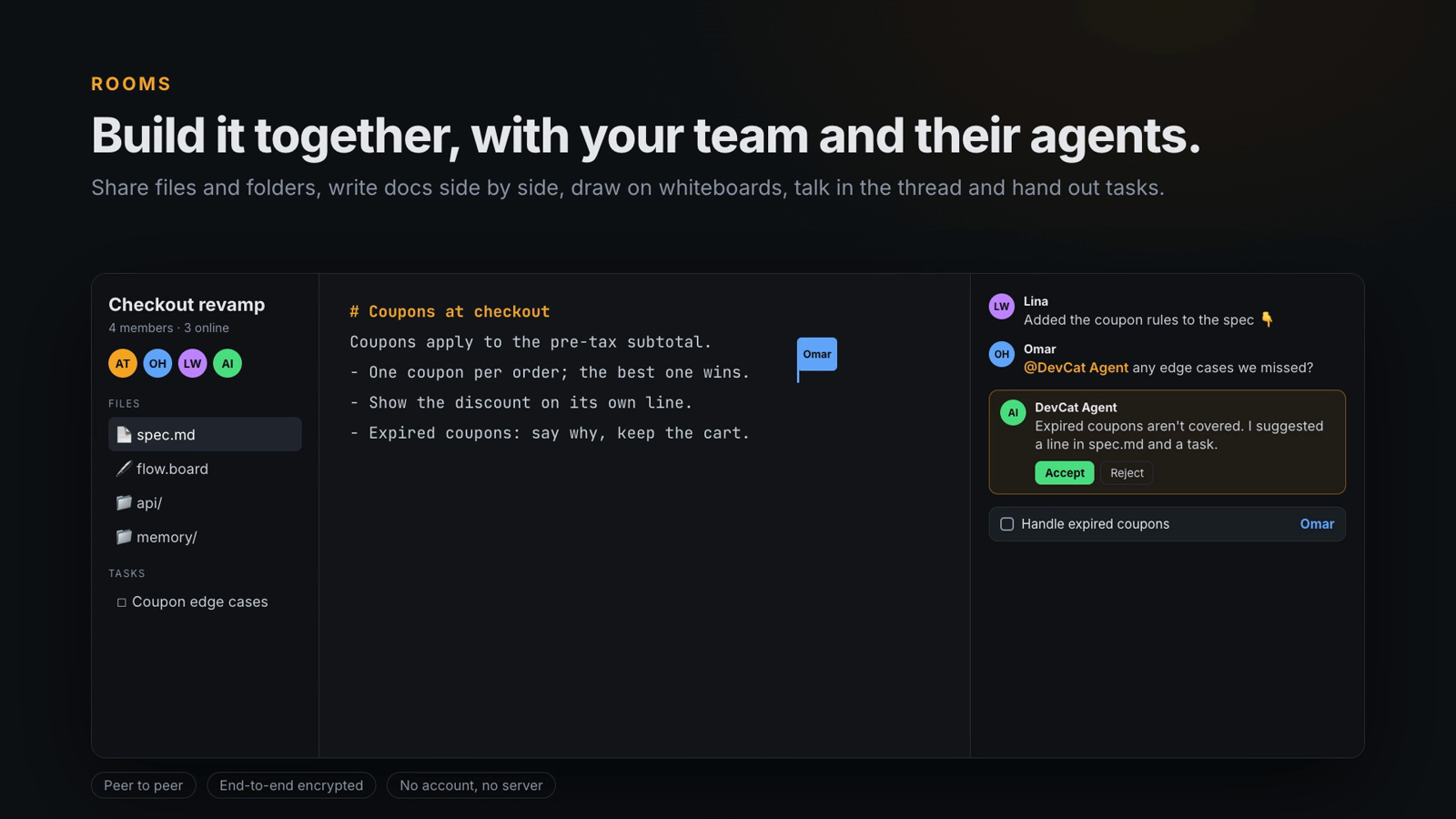
Rooms share files and folders, docs you write side by side, whiteboards, a thread and tasks with your team, peer to peer and end-to-end encrypted. No account, no server.

Mention anyone's DevCat Agent: it reads the room, takes tasks and suggests changes people accept or reject.

A room: a shared spec being edited by two people, the thread, the room's agent suggesting a change, and a task

Every repo in a folder

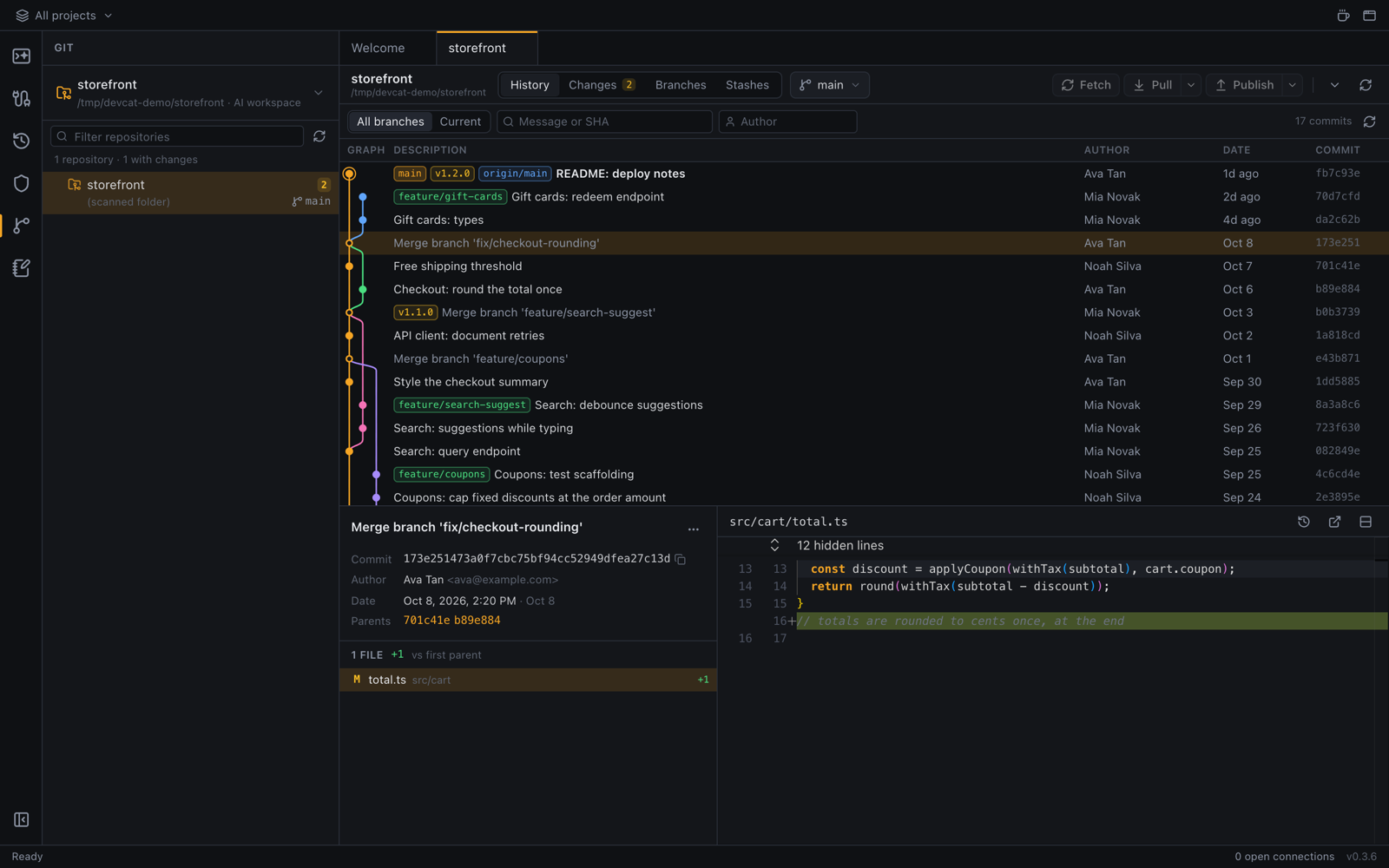
DevCat finds nested repositories and shows the commit graph, blame, branches, tags and stashes.

Fetch, pull and push from the same window.

The Git view with a commit graph and branch list

Your databases, with a proper SQL editor

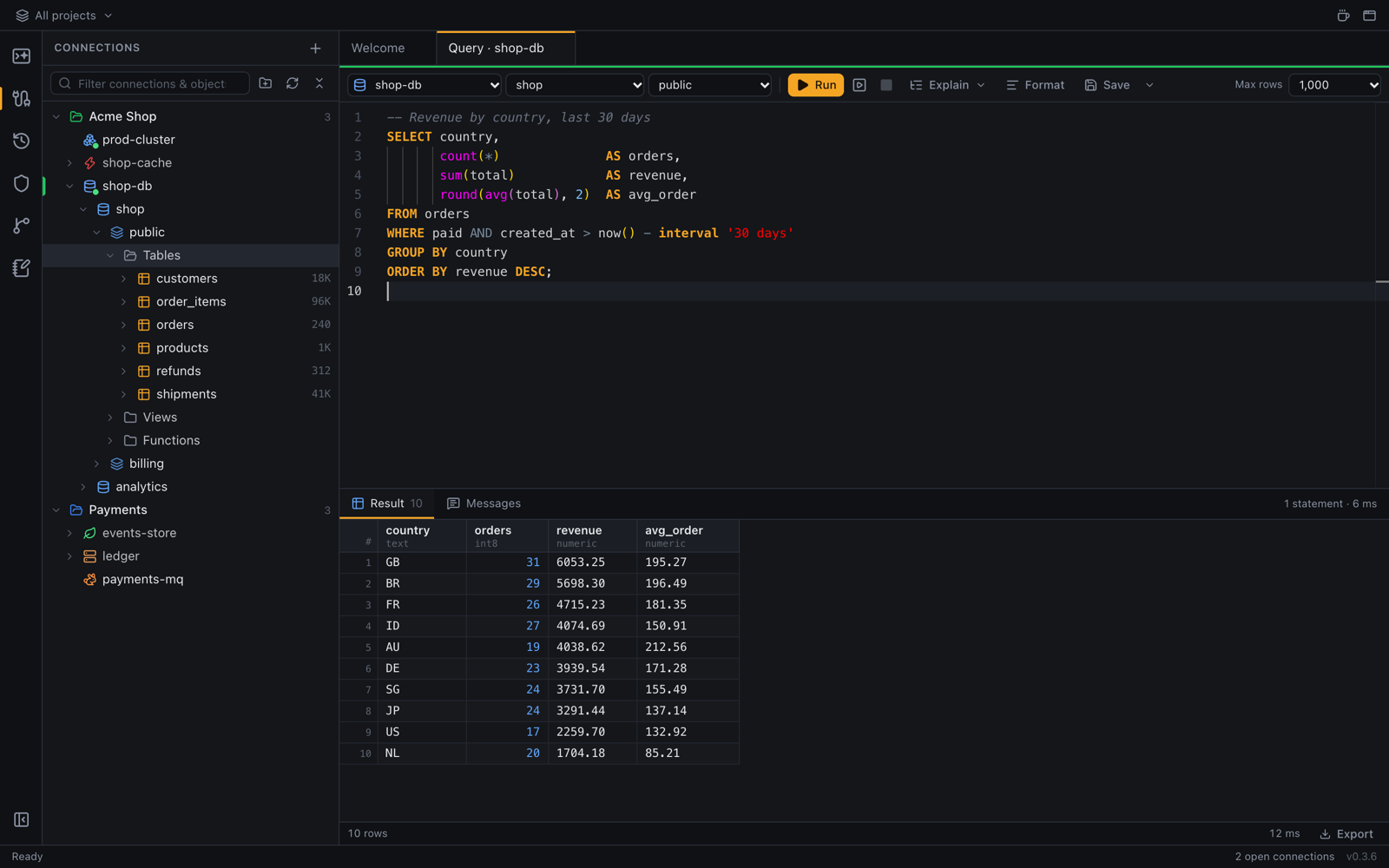
PostgreSQL, MySQL and MariaDB, SQLite, SQL Server, MongoDB and Redis. Browse and edit tables, compare schemas and move data between them.

Connections go through SSH tunnels when they need to, and passwords stay in your system keychain.

The SQL editor with a query and its results

Clusters and queues

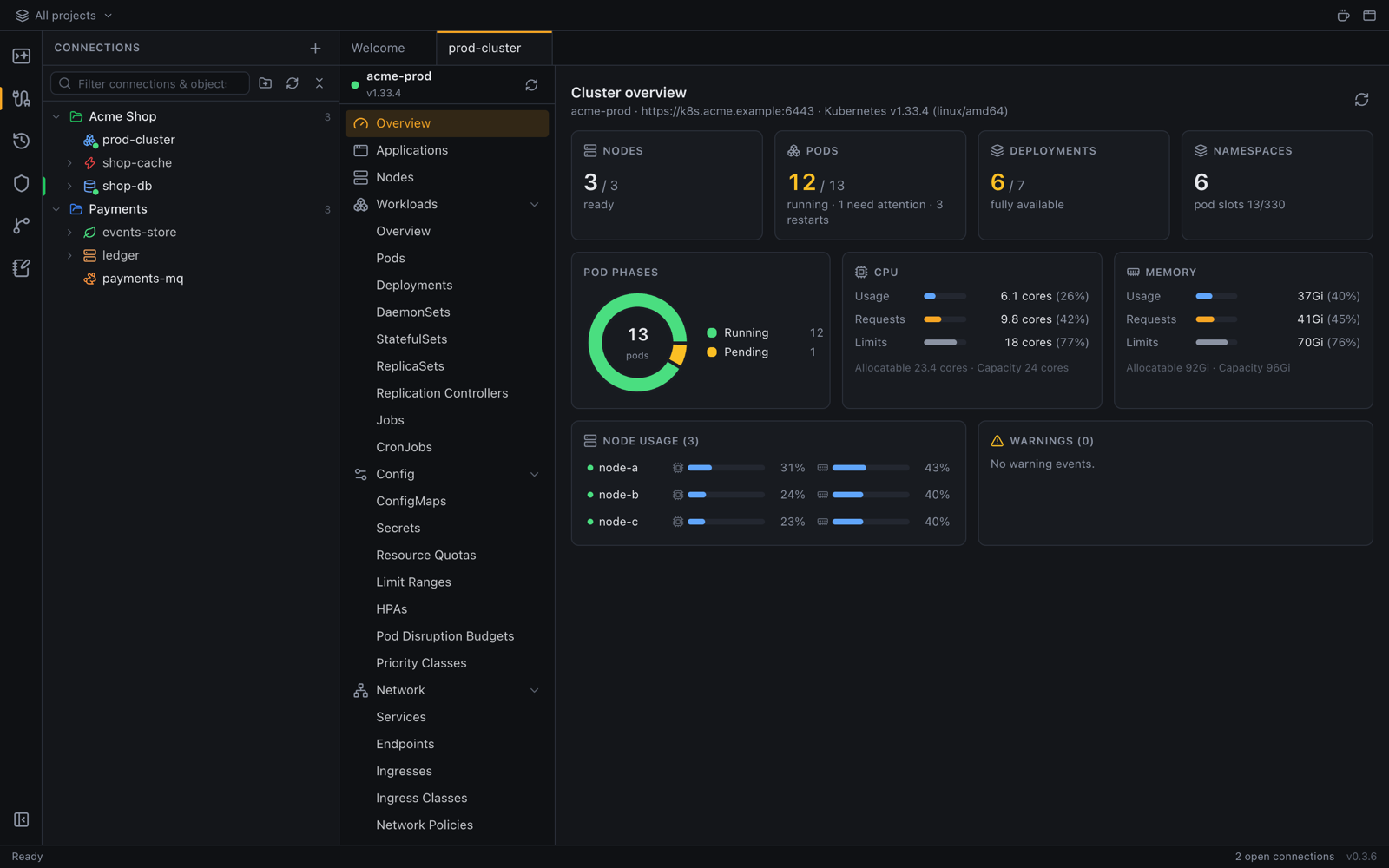
Kubernetes with any kubeconfig context: workloads, logs, a shell in any pod, port forwards and Helm releases. RabbitMQ through its management API.

The Kubernetes view with pods and their status

VPNs and SSH tunnels

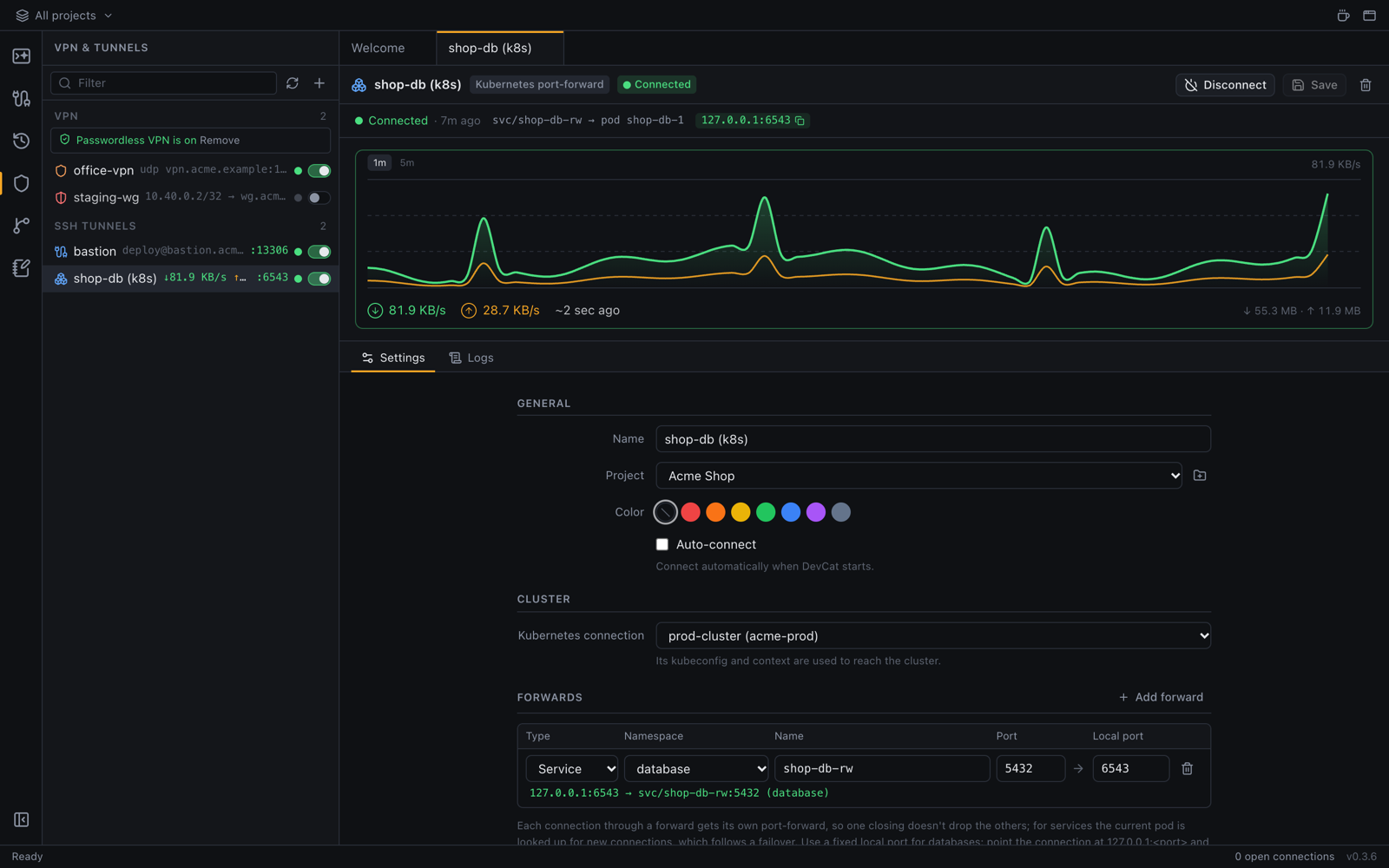
OpenVPN, WireGuard and SSH forwards, including a SOCKS proxy, with live traffic for each.

The network view with VPN connections and SSH tunnels

Keep your agents going from anywhere

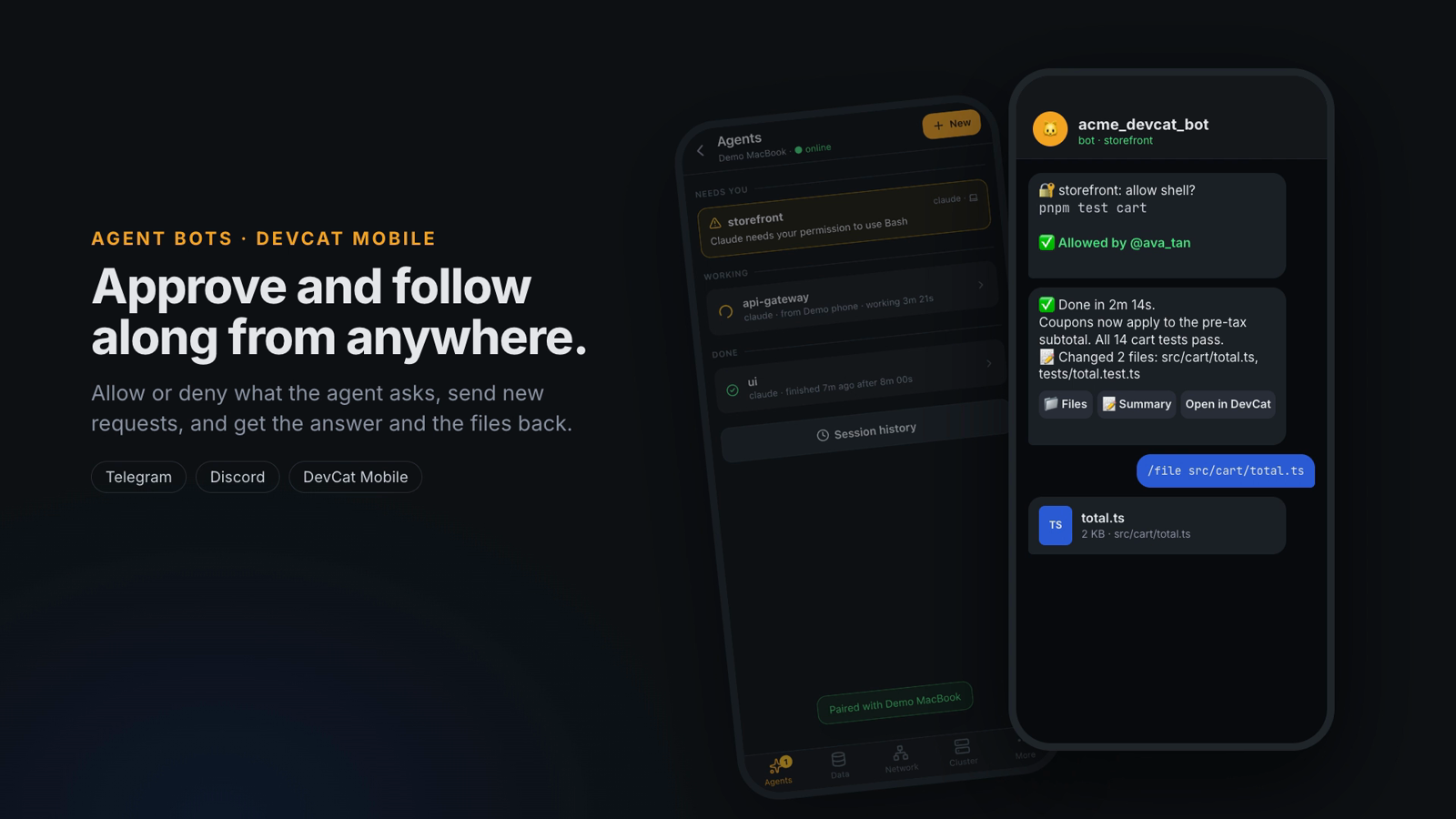
Link a Telegram or Discord chat to a project: Allow or Deny what the agent asks, send new requests, and get the answer and the files back.

DevCat Mobile for Android and iPhone does the same and more: reply, run a query or check a pod. It reaches your computer directly or through a relay that only passes encrypted traffic. No account to create.

Approving an agent's command from a chat app, next to DevCat Mobile

Install

Pick an installer from the latest release, or use a terminal. The scripts check the download's SHA-256 and install for your user only. New to DevCat? Start with First steps.

The app

macOS, with Homebrew
brew install --cask devcathq/devcat/devcat
macOS, Linux
curl -fsSL https://devcathq.github.io/DevCat/install.sh | sh -s -- --app
Windows PowerShell
& ([scriptblock]::Create((irm https://devcathq.github.io/DevCat/install.ps1))) -App

Only the CLI

For servers and SSH sessions: devcat serve shares your agents and connections with DevCat Mobile or a browser, without a window.

macOS, Linux
curl -fsSL https://devcathq.github.io/DevCat/install.sh | sh
Windows PowerShell
irm https://devcathq.github.io/DevCat/install.ps1 | iex